Bespoke Turkish Marble and Solid Wood Bathroom Vanity Combinations: Quarry Pairings, Stone-to-Timber Engineering, and Luxury Export Design
Pairing indigenous Anatolian natural stone with kiln-dried hardwood joinery represents the signature architectural capability of the import and export of solid wood bathroom cabinets in Turkey. Sitting atop the Alpine-Himalayan orogenic belt, Turkey holds nearly 40% of global marble and travertine reserves—spanning iconic quarries in Afyon, Denizli, Muğla, Bilecik, and Marmara Island—located within a few hours' road transit of major woodworking hubs in İnegöl, Istanbul, Ankara, and Izmir. Combining CNC-milled Turkish marble countertops and carved monolithic stone basins with solid wood bathroom cabinets creates cohesive, high-margin architectural assemblies that outperform synthetic quartz and laminate imports in both tactile luxury and global resale appeal.
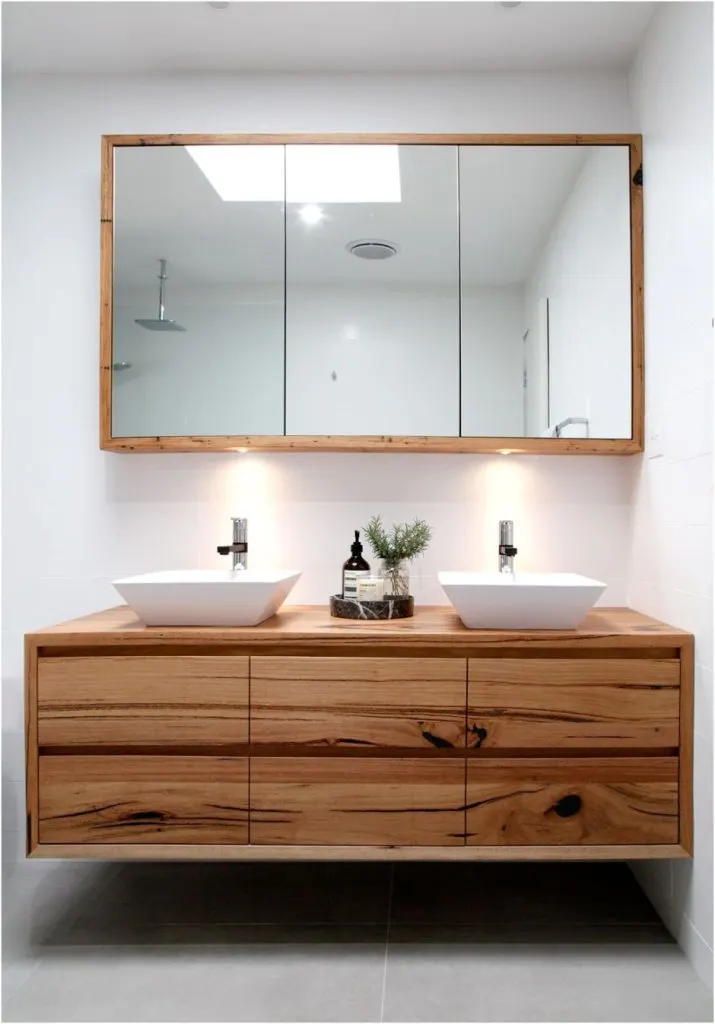
This technical design and fabrication guide explores bespoke Turkish marble and solid wood bathroom vanity combinations, examining geological stone properties, mineral-to-timber aesthetic pairings, differential thermal expansion engineering, waterjet sink integration, and export packaging protocols.
1. Geological Properties of Premier Turkish Marbles and Travertines
Not every quarried stone performs identically in wet bathroom environments. Understanding calcium-carbonate density, porosity, vein mineralogy, and surface finish options ensures bespoke Turkish marble and solid wood bathroom vanity combinations resist staining, etching, and structural stress across decades of daily use.
Turkish Stone Variety Quarry Region Geological Profile & Vein Aesthetic Porosity & Acid Sensitivity Recommended Surface Finish for Vanities
Afyon White & Afyon Sugar Afyonkarahisar (Aegean-Central) Fine-grained crystalline white with soft golden-amber sugar veining Low porosity; reacts to acids if polished Honed (Matte) to conceal micro-etching
Marmara White (Equatorial) Marmara Island (Balıkesir) Crisp white background with bold linear silver-gray parallel stripes; high natural sulfur Very dense, low porosity; historic Turkish hammam stone Honed or Brushed for contemporary linear geometry
Muğla Lilac (Milas Leylak) Milas / Muğla (Southwestern Aegean) Dramatic milky-white slab traversed by deep violet-charcoal web veining Dense metamorphic calcite; moderate acid sensitivity Honed or Leathered for statement sculptural tops
Denizli Vein-Cut Travertine Denizli / Pamukkale Warm beige, ivory, and walnut-banded sedimentary limestone with linear pores Naturally porous; requires clear or color-matched resin filling Resin-Filled & Honed for smooth water shedding
Toros Black (Alanya Black) Antalya / Taurus Mountains Deep jet-black calcite matrix laced with striking white and gold lightning veins Dense, low absorption; shows hard-water mineral spots if glossy Leathered or Satin-Honed to mask water droplets
Bilecik Beige (Rosalia / Emperador) Bilecik (Marmara-İnegöl corridor) Warm cream-beige or rich caramel-brown brecciated marble Low-to-moderate porosity; machines cleanly for mitered aprons Honed for warm traditional and transitional suites
Why Honed and Leathered Finishes Outperform High-Gloss Polish
Because marble and travertine are calcium-carbonate rocks, acidic grooming products (citric skincare serums, vinegar cleaners, certain toothpastes) chemically react with polished surfaces to leave dull "etch" marks. Specifying honed (velvety matte) or leathered (diamond-brushed textured) finishes on bespoke Turkish marble and solid wood bathroom vanity combinations diffuses light evenly, renders micro-etching virtually invisible, and harmonizes organically with dead-matte catalyzed wood coatings.
2. Signature Stone-to-Timber Architectural Pairings
Harmonizing stone veining with hardwood grain structure elevates bespoke Turkish marble and solid wood bathroom vanity combinations from standard bathroom fixtures into curated architectural focal points:
1. Muğla Lilac Marble + Book-Matched Turkish Walnut (Juglans regia)
• Visual Synergy: The dramatic purple-gray web veining of Milas Lilac marble echoes the rich smoky-espresso and purplish heartwood undertones of kiln-dried Turkish walnut.
• Architectural Execution: Fabricate a floating 150-centimeter vanity with a 100mm 45-degree mitered waterfall marble apron and a concealed linear slot drain over a book-matched Turkish walnut drawer base fitted with recessed antique bronze edge pulls.
2. Denizli Vein-Cut Travertine + Wire-Brushed Anatolian Chestnut (Castanea sativa)
• Visual Synergy: Warm sandy-ivory bands in vein-cut Denizli travertine blend seamlessly with the golden-ochre cathedral grain of Black Sea Anatolian chestnut.
• Architectural Execution: Pair a thick 60mm solid travertine countertop featuring a carved oval vessel basin with an open-frame wire-brushed chestnut console washstand—ideal for Aegean coastal villas in Bodrum, Çeşme, and Mediterranean boutique resorts.
3. Marmara Linear Marble + Fluted Rift-Sawn White Oak (Quercus alba)
• Visual Synergy: The crisp, parallel silver-gray striations of Marmara Island marble mirror the tight, vertical architectural rhythm of CNC-fluted rift-sawn white oak.
• Architectural Execution: Mount a 30mm honed Marmara marble slab with an undermount white porcelain bowl atop a floating vertical-fluted white oak cabinet finished in 3%-sheen dead-matte 2K aliphatic polyurethane.
4. Leathered Toros Black Marble + ThermoWood Ash (Fraxinus excelsior)
• Visual Synergy: Deep jet-black Taurus Mountain stone textured with diamond brushes pairs dramatically with roasted dark-brown thermally modified ash for moody, spa-inspired wellness suites.
3. Structural Engineering: Joining Heavy Stone Slabs to Solid Timber Carcasses
Marble and solid hardwood expand and contract at vastly different rates when exposed to hot shower steam and conditioned air. Rigidly gluing a 3-centimeter stone slab directly onto a solid wood cabinet box prevents natural cross-grain timber movement, leading to split wood panels or cracked stone corners.
Master Turkish fabricators engineer bespoke Turkish marble and solid wood bathroom vanity combinations using four structural rules:
1. Full-Depth Structural Hardwood Web Frames: Construct the top of the timber carcass with 22mm solid hardwood front-to-back stretchers spaced every 45 centimeters to distribute the 80–90 kg/m² dead weight of 3cm marble slabs without mid-span deflection.
2. Slotted Steel Z-Clips and Elastomeric Silicone Pads: Anchor the stone slab to the timber web frame using slotted steel figure-8 fasteners paired with flexible neutral-cure sanitary silicone dabs along perimeter rails—allowing the hardwood carcass to expand laterally beneath the stone without transmitting shear stress.
3. CNC-Carved Monolithic Integrated Stone Basins: Instead of cutting large holes for drop-in sinks that weaken narrow stone aprons, Turkish CNC bridge saws and 5-axis waterjets mill complete monolithic ramp-drain basins from solid 120mm–150mm marble blocks, reinforced underneath with concealed fiberglass-mesh backing rods for structural impact resistance.
4. Neutral-Cure Sealing Discipline: Strictly use non-staining, neutral-cure stone-grade silicone around basin rims and wall backsplashes; standard acetoxy silicones leach acetic acid and plasticizers that permanently stain porous white Afyon and Muğla marbles yellow.
4. Breathable Fluoropolymer Impregnation Before Export Crating
Before crating bespoke Turkish marble and solid wood bathroom vanity combinations for international shipment, stone fabricators apply two coats of solvent- or water-based breathable fluoropolymer impregnating sealer. Unlike topical acrylic waxes that trap moisture and peel in humid bathrooms, penetrating impregnators bond 3 to 5 millimeters inside the stone's microscopic capillaries—repelling colored soaps, hair dyes, and skincare oils while allowing water vapor to transpire naturally.
5. Co-Crated Export Packaging for Stone + Solid Wood Ensembles
Shipping heavy Turkish marble tops alongside finished solid wood vanities in the import and export of solid wood bathroom cabinets in Turkey requires specialized dual-medium packaging inside ISPM-15 heat-treated wooden crates:
• Dry-Fit Verification Prior to Disassembly: Every stone top and undermount basin is dry-fitted onto its exact numbered wooden carcass on the Turkish factory floor to confirm sub-millimeter faucet hole and drain alignment.
• Vertical Edge-Loaded Stone Crating: Marble countertops are separated from wooden cabinets inside partitioned crates and stood vertically on their long edge over high-density rubber shock pads—never laid flat horizontally, where ocean vessel vibration can snap stone across basin cutouts.
• Vapor-Barrier Timber Isolation: The accompanying solid hardwood vanity is sealed inside its own 150-micron aluminized vapor-barrier foil bag with silica desiccants, ensuring stone residual humidity never transfers into the kiln-dried 6%–8% EMC timber during maritime transit.