Common Console Table Design Mistakes in Hotels and How to Avoid Them
Most console table problems in hotels start on paper, not in the factory. This guide collects the typical specification and design errors we see on projects and shows how to prevent them.
Most console table design mistakes in hotels are not manufacturing faults. They are decisions made on paper: a depth that blocks a corridor, a corner that catches luggage, a top that stains in the first month. Because a console table looks simple, it is often specified quickly and checked late.
This article collects the errors that appear again and again on hospitality projects, explains why they happen and shows how to avoid them before production starts. We build custom pieces to project drawings in our Istanbul factory and ship worldwide, so the points below come from the practical side of ordering made-to-order furniture.
Why console tables go wrong more often than expected
A console table sits in the most visible and most trafficked parts of a hotel: entrances, corridors, lobbies and suite entry areas. It is touched, bumped and used as a shelf for keys, bags and drinks. A small design weakness therefore shows up quickly.
Another reason is responsibility. A console is neither fixed joinery nor a typical loose item in a room schedule, so it may fall between the architect, the interior designer and the contractor. Nobody checks the clearances, the finish or the fixing method in detail.
Mistake 1: Choosing the wrong depth
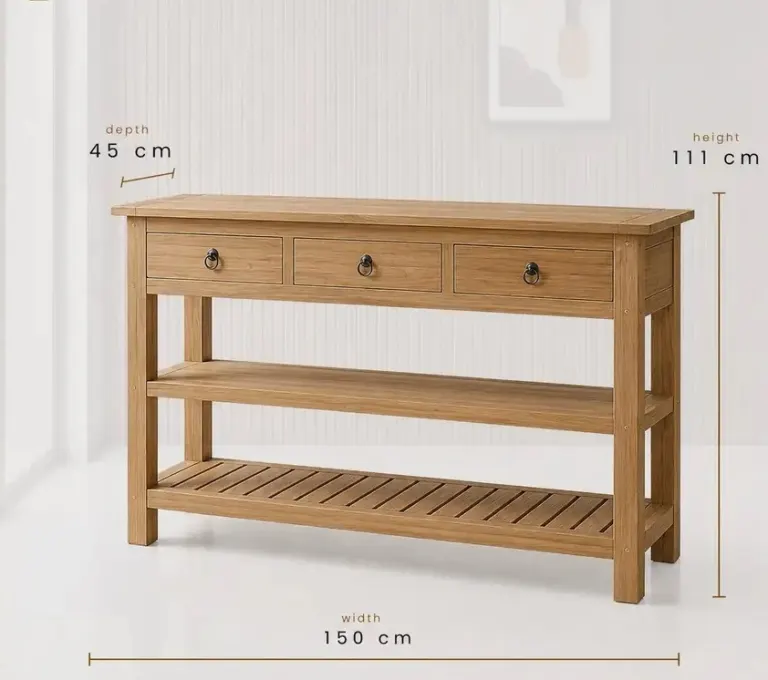
Depth is the most common proportion problem. A table that looks elegant in a render at 40 cm (15.7 in) deep may narrow a corridor or entry niche more than the plan allows. On the other hand, a very shallow piece of 20 cm (7.9 in) looks refined but cannot hold a lamp base or a tray safely.
To avoid this:
- Measure the clear walking width left after the table is in place, not just the table footprint.
- Check the depth against the objects it must carry, such as a lamp, a flower arrangement or a phone charger.
- Confirm that doors, wardrobe doors and lift doors do not swing into the piece.
- Ask for a full-size cardboard or timber template on site if the space is tight.
Accessibility and fire rules for escape routes vary by country, so check the local requirements with your consultant rather than relying on a standard depth.
Mistake 2: Leaving sharp corners and edges
Square, thin edges look crisp in drawings but chip easily and can injure guests in dim corridors. Luggage, housekeeping trolleys and children all meet console corners at the worst possible height.
Better practice includes:
- Specify a small radius on all exposed corners, even when the design language is angular.
- Choose an edge profile that suits the material. Veneered tops with a very thin edge are more vulnerable than tops with a solid wood edge or a slightly thicker build-up.
- Mark the corner radius clearly on the drawing, in millimetres, so the factory does not interpret it.
Mistake 3: Unprotected tops
The top takes the heat, liquids and scratches. A natural-looking matte finish may be attractive but can mark with a single wet glass if the coating is not suited to hospitality use. Tops are often specified by colour only, with no mention of the coating system or the expected use.
Consider these questions before approving a top:
- Will drinks, ice buckets or hot items be placed here, for example near a bar or a restaurant host stand?
- Is the finish a hard-wearing lacquer, an oil that can be refreshed, or a laminate or stone surface?
- Can housekeeping repair or refresh the surface on site?
Where a console is likely to hold glasses, a stone, glass or high-pressure laminate top on a wooden base is often a more practical answer than a delicate natural finish.
Mistake 4: Overlooking stability and wall fixing
Tall, slim consoles with thin legs can wobble on uneven floors or tip when a guest leans on them. Wall-mounted designs fail when the wall type is not considered, since plasterboard, brick and concrete need different fixings.
- Plan adjustable feet or levelling solutions for floors that are not perfectly flat.
- Specify the wall fixing method and confirm the wall construction behind it.
- Check the leg-to-top connection on drawings, because this is where looseness usually begins.
Mistake 5: Ignoring the wall and the skirting board
Many consoles are designed as if the wall were perfectly flat and had no skirting. In reality, skirting boards, wall panelling and sockets get in the way, and the table either stands away from the wall or leaves a visible gap.
Solve this with a simple site survey. Note the skirting height and projection, socket positions and any wall protrusions. If needed, the back of the piece can be notched, or a back panel can be added to protect the wall and to hide cables.
Mistake 6: Specification errors in finish and material
Typical specification errors are quiet ones. A drawing may say "oak, natural" without naming veneer or solid wood, the sheen level, or the colour reference. The factory then makes a reasonable guess, and the owner expects something different.
A clear specification should state:
- Material: solid timber, veneer on board, or a combination.
- Finish type and sheen: matte, satin or gloss.
- Colour reference: a physical sample, a RAL code for lacquers or a stain card.
- Edge details and corner radius.
- Quantity of each size and any variations between locations.
Colour approval should always be based on a physical sample viewed in the actual lighting of the hotel, since daylight and warm artificial light change how wood looks.
Mistake 7: Skipping a sample or a mock-up
A console order often seems too small to justify a prototype. Yet the cost of a sample is usually modest compared with replacing a full batch. A sample shows proportion, finish, weight and joinery in a way that a render cannot. It also allows the operator to place real objects on the top.
For repeated pieces, agree what level of variation between the sample and the production run is acceptable, particularly with natural veneers and timber.
Mistake 8: Forgetting the export journey
A design that works in the showroom can suffer in transit. Slim legs, overhanging tops and projecting details are exposed during sea or road freight. Stone or glass tops need separate protection.
When you order from overseas, discuss packing early. Ask whether the piece ships assembled or knock-down, how corners and tops are protected, and how each item is labelled for delivery to the right floor or room. Shipping terms such as FOB, CIF or DAP should be agreed before production, since they affect who carries the risk at each stage.
A quick pre-approval checklist
| Check | Question to ask |
|---|---|
| Depth and clearance | Is the walking width still acceptable with the table in place? |
| Corners and edges | Is the radius stated on the drawing? |
| Top protection | Does the finish suit liquids, heat and scratches? |
| Stability | Are levelling and wall fixing defined? |
| Wall contact | Have skirting and sockets been checked? |
| Specification | Are material, finish and colour reference unambiguous? |
| Sample | Has a physical sample been approved on site? |
| Packing | Is the export packing method agreed? |
Conclusion
Avoiding these hotel furniture errors takes little extra effort: a site check, a clear drawing, a physical sample and a realistic view of how the piece will be used. Most of the problems above can be solved on paper at almost no cost, while the same problems found after delivery are slow and expensive to fix.
If you are planning console tables for a new hotel or a renovation, send us your drawings, photos or a short brief. We will review the details, point out possible risks and suggest options for materials, finishes and shipping to your destination.
Sıkça Sorulan Sorular
What is the most common console table design mistake in hotels?
Choosing the wrong depth is probably the most frequent issue. A table that is too deep narrows corridors and entrances, while one that is too shallow cannot carry lamps or trays safely. Checking the clear walking width on site, and not only the table size on the drawing, prevents most of these problems.
How can I protect a wooden console top from drinks and heat?
Choose a hard-wearing finish designed for hospitality, such as a quality lacquer, or use a stone, glass or high-pressure laminate top on a wooden base. Ask the factory what coating system is used and request a sample so you can test it against typical daily use before approving production.
Should console table corners be rounded in a hotel?
In most cases yes. A small radius on exposed corners reduces chipping and lowers the risk of injury from luggage and trolleys. Even in angular designs, a slight softening is usually possible. State the radius in millimetres on the drawing so the factory builds exactly what you expect.
Do I need a sample before ordering console tables from overseas?
A sample is strongly recommended, even for small orders. It lets you check proportion, finish colour, weight and joinery in your own lighting. It also gives both sides a clear reference for production, which reduces disputes about small differences later on.
Can you produce console tables to our drawings and ship them worldwide?
Yes. We manufacture to project drawings in our own factory in Istanbul and arrange export packing and shipping to many regions. Send your drawings, photos or brief, and we will review materials, finishes, quantities and the shipping terms that suit your project.
Every hotel project is different. Send us your drawings or room schedule for a tailored proposal on materials, lead time and shipping.