Console Table Shapes for Hotels: Rectangular, Round, Oval and Half-Moon Compared
Console table shapes affect how guests and staff move through a space as much as how the piece looks. This guide compares four footprints by circulation, clearance and usable surface.
The most useful way to compare console table shapes in a hotel is to look at the floor, not the render. A rectangular console, a half-moon, an oval and a round pedestal table each take up a different footprint, and each changes how guests, luggage and housekeeping trolleys pass by. This guide compares the four shapes by circulation flow and space use, so you can shortlist the right footprint before style and finish enter the discussion.
Why footprint matters more than outline
In a showroom, a console table is judged on its looks. In a hotel corridor, lobby or suite, it is judged by whether people can walk past it with a suitcase. The same length and depth can behave very differently depending on whether the corners are square, rounded or fully curved.
Three measurements help you compare shapes fairly:
- Maximum projection: the deepest point of the piece from the wall.
- Effective depth at the edges: how deep the table is where people actually brush past it.
- Usable surface: the flat area where a lamp, tray, flowers or a key-card display can sit without crowding.
Keep these three in mind as we go through each shape. Exact dimensions always depend on the project, so treat the notes below as planning logic rather than fixed rules.
Rectangular console tables
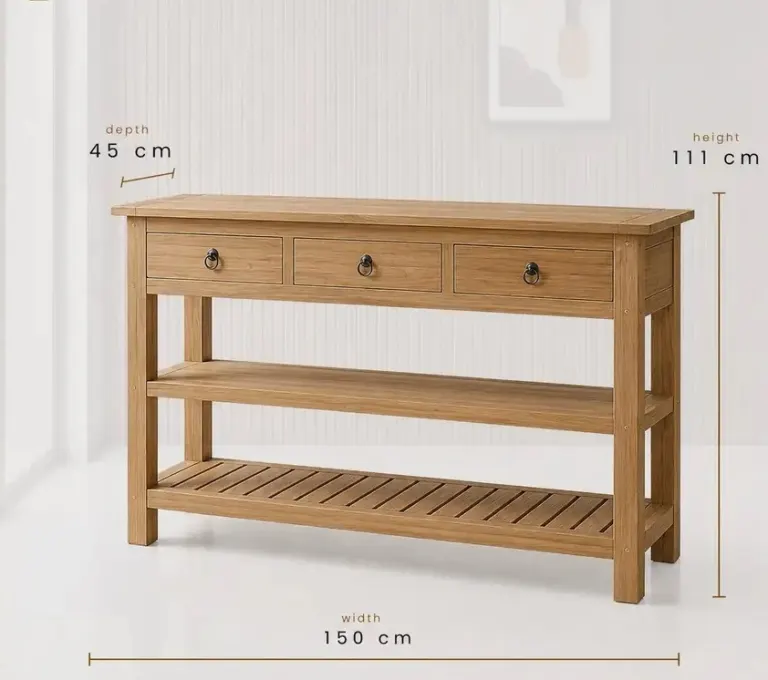
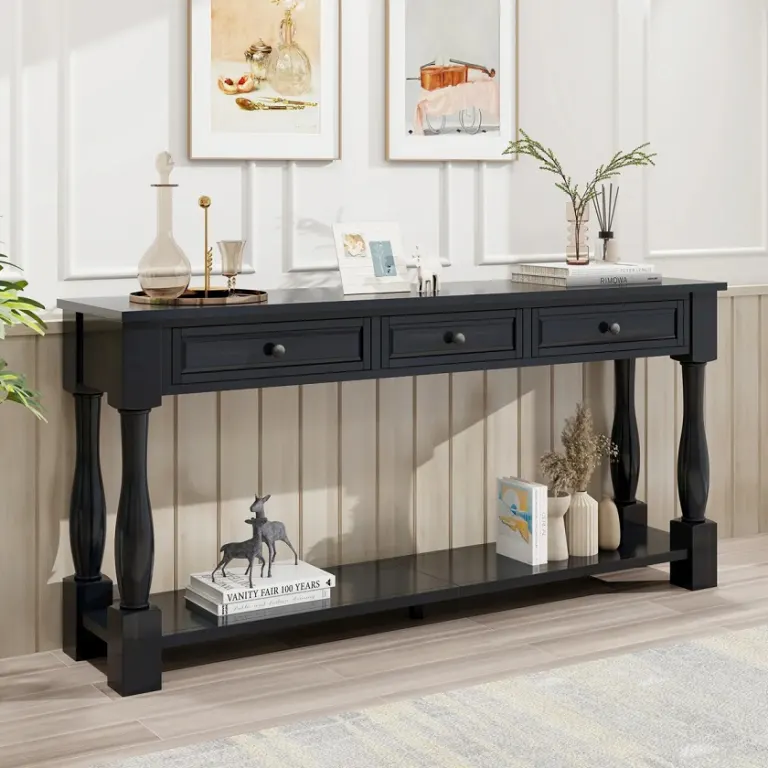
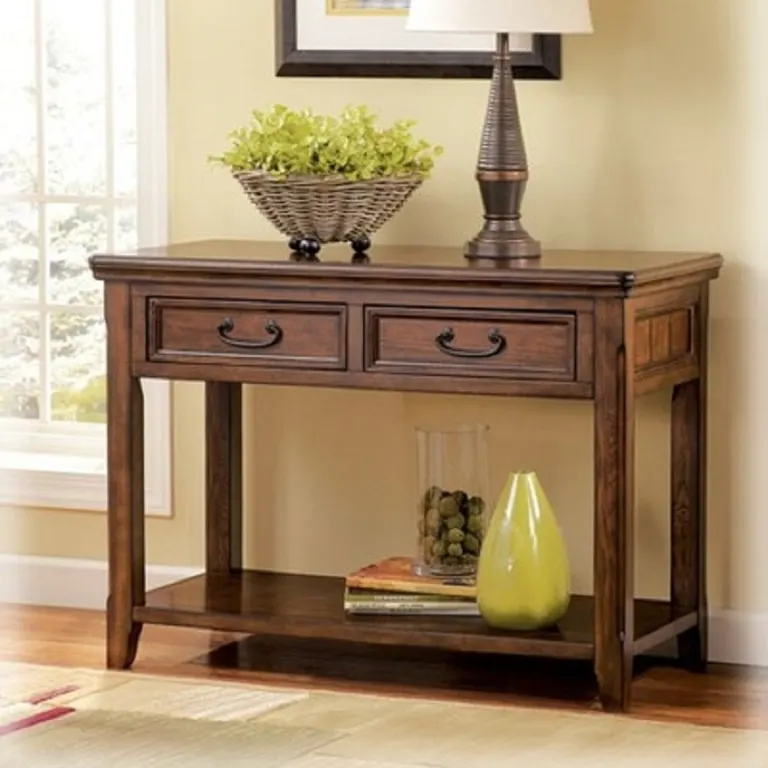
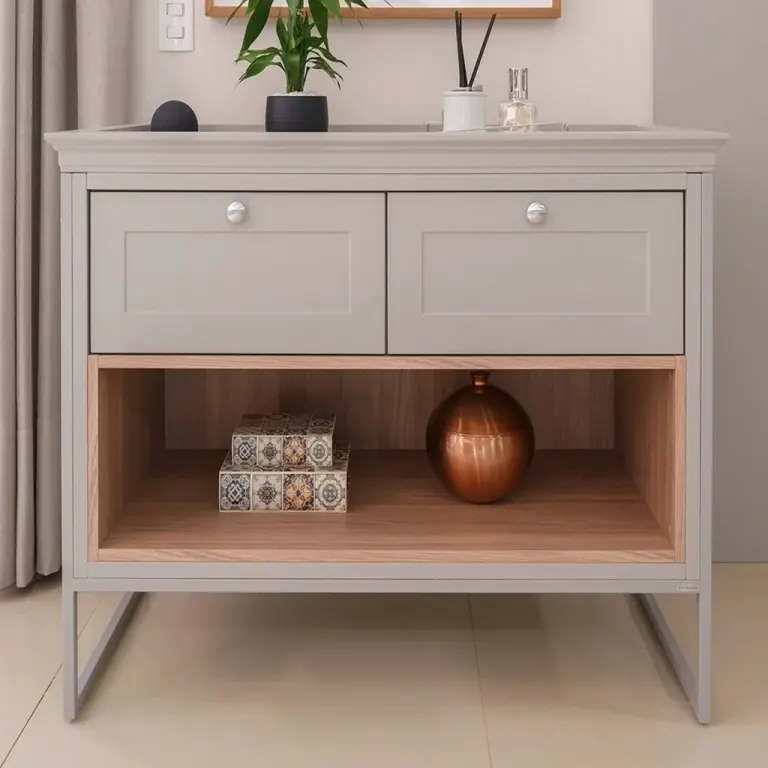
The rectangular console table is the default for a reason. It sits flat against a wall, uses its full length as usable surface and is the simplest shape to draw, produce and install. It is also the easiest to pair with a wall mirror or artwork of the same width.
Circulation behaviour
A rectangle presents square corners at its front edge. In a narrow corridor those corners are the contact points for hips, bags and trolleys. If the depth is generous, the corner is more noticeable; if the depth is slim, it matters less. Slim depths, for example 25 to 35 cm (10 to 14 in), are common where circulation is tight, but you should confirm the clearance with your own layout and the local accessibility rules.
Best uses
- Long, straight walls in lobbies and corridors.
- Under-TV walls and entry niches in guest rooms.
- Restaurant host stands and service stations that need maximum flat surface.
- Any case where a built-in look against the wall is the goal.
Watch points
Square corners can be softened with a small radius on the top and legs, which costs little in production and reduces knocks. A rectangle also reads as a hard line, so in a curved lobby it can look disconnected from the architecture.
Half-moon (demilune) console tables
A half-moon console table has a straight back and a curved front. This gives you a flat edge that sits flush with the wall and a rounded front that guides people around the piece. It is often the first alternative buyers consider when a rectangle feels too sharp for the space.
Circulation behaviour
The curve means the table is at its deepest only in the centre. At the ends, the effective depth falls to almost nothing, so the passing zone is wider than with a rectangle of the same maximum depth. This makes the shape helpful in entrance areas where guests approach from both sides.
Space use
You pay for this in surface. Because the corners are cut away, the flat area available for objects is smaller than on a rectangle of the same width and depth. Items placed near the ends may sit awkwardly on the curve, so plan the styling around the central zone.
Best uses
- Entrances, reception backdrops and lift lobbies where a softer approach is wanted.
- Pairs of half-moons on either side of a door or opening.
- Short wall sections where a full rectangle would feel heavy.
Watch points
Curved fronts and curved aprons need more complex production than straight parts, whether the top is veneered, solid or laminated. The shape needs a clear drawing and a sample, and it affects both cost and lead time. Where a drawer is required, the curve limits the drawer shape and internal space.
Oval console tables
An oval console table has a continuous curve on all sides. It can stand against a wall, but it is more often placed where it can be seen from several angles, such as a freestanding position behind a sofa or near a circulation node.
Circulation behaviour
An oval offers the gentlest edge for people walking past, with no corners at all. It guides movement along its long axis, which suits areas where traffic follows one main direction. When placed against a wall, however, the curved back leaves an unused gap behind the table, which can collect dust and look unresolved.
Space use
The oval wastes more floor than a rectangle for the same usable surface, because the ends narrow quickly. It is therefore a better fit for generous spaces than for compact rooms. In a small guest room, an oval console would take up floor area without giving much surface in return.
Best uses
- Open lobby zones and lounges where the table is seen from all sides.
- Suite living areas behind a sofa, as a divider between zones.
- Feature positions that carry a larger floral arrangement or sculpture.
Watch points
If the piece is meant to sit near a wall, ask whether a flat-backed version is better. Also check how the oval will be moved and shipped, because curved tops often need shaped packaging to protect the edges.
Round console tables
Strictly speaking, a round table is not a console in the traditional sense, but buyers often request a small round or pedestal piece for entry and landing positions. It behaves differently from the other three shapes and deserves a separate look.
Circulation behaviour
A round top has the same projection in every direction, so it never presents a long edge to passers-by. Placed in the middle of a lobby or landing, it is easy to walk around from any side. Against a wall, it wastes the most floor area of all four shapes.
Space use
The surface is compact and symmetrical, which works well for a single focal object such as a lamp or floral arrangement. It does not suit multiple items, trays or service use. A pedestal base also tends to be more stable when the leg is wide enough, but weight and tipping risk should be checked in the drawing, particularly for tall or top-heavy designs.
Best uses
- Central lobby positions, stair landings and rotunda spaces.
- Elevator lobbies where a small, soft-edged feature is wanted.
- Entrances where a single decorative object is the focus.
Side-by-side comparison
| Shape | Wall contact | Edge behaviour in circulation | Usable surface | Typical position |
|---|---|---|---|---|
| Rectangular | Full length | Square corners; can be rounded | Highest for its size | Corridors, entry walls, service areas |
| Half-moon | Straight back | Soft, tapering edge | Medium | Entrances, reception, lift lobbies |
| Oval | Limited if against a wall | No corners; guides movement | Medium to low | Open lounges, suite dividers |
| Round | Point contact | Equal in all directions | Compact | Central or landing positions |
How to choose by space type
Narrow corridors
Choose a slim rectangular console table with softened corners, or a shallow half-moon if the corridor is slightly wider at one point. Keep the clear passage in line with your fire and accessibility requirements, which vary by country and project.
Entrance lobbies
A half-moon or oval often feels more welcoming, especially when guests arrive with luggage. A rectangle works if the wall is long and the design is architectural rather than decorative.
Guest rooms
Floor area is limited, so a rectangular or wall-mounted model usually wins. Curved shapes are better kept for suites with enough space to absorb the lost surface.
Restaurants and bars
Where staff pass frequently with trays, the circulation edge matters more than the outline. A rectangle with radiused corners keeps surface and workflow balanced.
Production notes for custom orders
We make console tables to project drawings in our Istanbul factory and ship them to hotel projects worldwide. When you send a brief, include the plan view of the space, not only the table drawing. It lets us check the footprint against doors, columns and walkways.
- Specify the maximum projection and the depth at the ends for curved shapes.
- Tell us whether the back should be flat for wall contact or curved for freestanding use.
- Confirm quantities per shape, as curved parts can be more complex to produce in repeated batches.
- Approve a sample or mock-up for any curved model before mass production.
Shipping also varies by shape. Curved tops and bases may need custom packing to protect the edges, so discuss packing and Incoterms such as FOB or DAP early in the project.
Conclusion
The right shape is the one that fits the walking route and the available floor, then supports the design. Rectangles give the most surface, half-moons soften entrances, ovals suit open spaces and round pieces work as central accents. If you are comparing console table shapes for a hotel project, send us your plan drawings or a space list and we will review the options and come back with a suggested footprint, material advice and a quotation.
Sıkça Sorulan Sorular
Which console table shape saves the most space in a hotel corridor?
A slim rectangular console table is usually the most space-efficient, because it sits flat against the wall and gives the most surface for its depth. A shallow half-moon can feel more open at the ends, but you lose some usable surface. Always check clear passage against local regulations.
Is a half moon console table more expensive to make than a rectangular one?
Often yes, because curved tops, aprons and edges need more complex cutting, shaping and finishing than straight parts. The difference depends on materials, finish and quantity, so we price each project from its drawings rather than giving a standard rate.
Can an oval console table sit against a wall?
It can, but the curved back leaves a gap behind the table that wastes floor space and collects dust. If the piece will be wall-facing, a half-moon or a flat-backed oval is usually a better choice. Freestanding positions suit a full oval.
Do curved console tables need special packing for export?
Curved tops and bases usually need shaped protection around the edges, plus careful crating to avoid pressure on thin sections. Packing depends on material, size and shipping route, so we confirm the method with you before production begins.
Can you make console tables in different shapes for one hotel?
Yes. Many projects use rectangular pieces in corridors and rooms, and half-moon or oval pieces in lobbies. We can keep wood species and finish consistent across shapes, and we recommend approving a sample for any curved model.
Every hotel project is different. Send us your drawings or room schedule for a tailored proposal on materials, lead time and shipping.