Manufacturing of Bathroom Cabinets with Shutter-Style Doors: CNC Louver Milling, Pre-Assembly Coating Engineering, Wet-Zone Substrates, and Industrial QC Protocols
The Manufacturing of Bathroom Cabinets with Shutter-Style Doors is one of the most technically intricate workflows in industrial architectural millwork and wet-zone cabinetry production. Unlike flat-slab melamine vanities—which rely on high-speed panel saws and linear edge-banders—the Manufacturing of Bathroom Cabinets with Shutter-Style Doors requires multi-axis CNC mortising, precision slat profiling, pre-assembly edge isolation, multi-angle robotic or pressurized spray finishing, and marine-grade carcass construction engineered to endure 90%+ relative humidity spikes without swelling, warping, or joint failure.
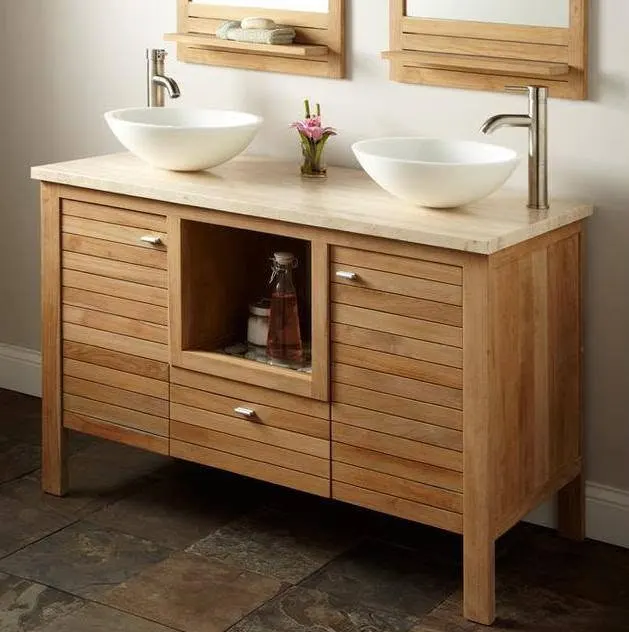
In modern export-oriented woodworking plants across Türkiye’s premier furniture clusters (Istanbul, İnegöl, Izmir) and leading European millwork facilities, the Manufacturing of Bathroom Cabinets with Shutter-Style Doors follows a disciplined, eight-stage engineering protocol. This technical monograph details the exact machinery, substrate science, louver joinery tolerances, catalyzed coating chemistry, and quality assurance benchmarks governing the Manufacturing of Bathroom Cabinets with Shutter-Style Doors.
1. Raw Material Selection and Climate Stabilization
Every stage in the Manufacturing of Bathroom Cabinets with Shutter-Style Doors depends on selecting dimensionally stable, moisture-resistant substrates capable of holding razor-sharp louver mortises without fiber tear-out or steam-induced swelling.
Substrate Specifications by Component
Cabinetry Component Recommended Industrial Substrate Technical Specification & Engineering Rationale
True Open-Slat Louver Blades 7 mm – 8 mm Green-Core HMR MDF (or Kiln-Dried Hard Maple / Thermo-Ash) High-density (780–820 kg/m³) Melamine-Urea-Formaldehyde (MUF) bonded HMR MDF exhibits ≤ 5%–6% 24-hour thickness swelling, zero cross-grain expansion, and glass-smooth lacquer readiness.
Vertical Stiles & Horizontal Rails 20 mm – 22 mm Kiln-Dried Hardwood (6%–8% EMC) or 22 mm HMR MDF Solid White Oak, Hard Maple, or Thermo-Treated Ash provides high screw-holding retention for concealed hinge cups while HMR MDF prevents paint-line movement.
Monolithic Faux-Louver Doors 22 mm Green-Core HMR MDF Single-slab construction deeply routed via 5-axis CNC eliminates glue joints completely for high-splash vanity drawers beneath basins.
Vanity Carcass (Cabinet Box) 18 mm – 20 mm Phenolic Marine Plywood (Su Kontrası) or 18 mm HMR MDF Marine plywood restricts 24-hour swelling to ≤ 2%–3%, preventing structural distortion in humid bathrooms and cantilevered floating vanities.
Structural Back Panels 8 mm – 10 mm Melamine/Veneered Plywood or HMR MDF Recessed into deep rear CNC grooves to deliver diagonal racking rigidity and house heavy-duty concealed wall-hanging brackets.
72-Hour Warehouse Acclimatization
Prior to machining, all raw MDF and kiln-dried hardwood packs are stored in climate-controlled halls maintained at 20°C–22°C and 50%–55% relative humidity for a minimum of 72 hours. Quality control technicians verify internal moisture equilibrium (6.0% to 8.0%) using calibrated pinless dielectric moisture meters before releasing boards to the cutting lines.
2. Precision Louver Profiling and Multi-Axis CNC Mortising
The defining structural challenge in the Manufacturing of Bathroom Cabinets with Shutter-Style Doors is machining dozens of identical angled louver pockets and tenons within sub-millimeter tolerances so slats fit snugly without twisting the door frame.
Slat Moulding and Micro-Radiusing
1. Four-Side Moulder / CNC Slat Profiling: Raw slat strips are milled to 6.5 mm–8.0 mm thickness and 32 mm–45 mm width using polycrystalline diamond (PCD) cutterheads.
2. Mandatory 1.5 mm Bullnose Edge Radiusing: Liquid primers pull away from sharp 90-degree edges due to surface tension (edge-thinning). Every louver blade is profiled with a 1.5 mm rounded bullnose radius along both front and rear edges so catalyzed coatings achieve full 140–180 micron Dry Film Thickness (DFT) across every tip.
3. Precision Tenon End-Milling: Both ends of each louver blade are shoulder-tenoned to match the exact depth and pitch angle of the stile mortises.
CNC Stile Mortising & Pitch Angle Geometry
• Angled Mortise Slotting (38° to 45° Pitch): Vertical stiles are machined on multi-spindle CNC louver mortising centers (such as Koch, Biesse, or Balestrini work centers) that mill 5 mm to 6 mm deep angled pockets spaced evenly to maintain a 4 mm to 7 mm convective air gap between adjacent louvers.
• Central Divider Rail Integration: On linen tower doors taller than 1400 mm, engineers incorporate a 70 mm wide horizontal mid-rail joined via haunched mortise-and-tenon joinery to divide the louver span into two rigid sections and prevent mid-span slat flexing.
3. Pre-Assembly Priming and Waterproof Door Assembly
A critical differentiator between industrial-grade Manufacturing of Bathroom Cabinets with Shutter-Style Doors and low-cost workshop carpentry is pre-assembly slat finishing.
Why Pre-Assembly Priming Is Mandatory
Once louver blades are glued into vertical stiles, spray guns cannot reach the hidden tenon ends inside the mortise sockets, and tight corners where slats meet stiles are prone to thin film coverage. Top-tier factories execute a two-phase finishing sequence:
1. Pre-Assembly Slat & Pocket Priming: Individual louver blades and CNC-milled stile pockets are sprayed with two-component (2K) polyurethane edge isolator and high-build primer, thermally cured, and orbitally denibbed with 320-grit abrasives before assembly.
2. Waterproof D4 / PUR Frame Clamping: Pre-primed louvers are inserted into the stile pockets using EN 204 D4 waterproof cross-linking PVAc or Polyurethane (PUR) woodworking adhesive and pressed in pneumatic squaring clamps, holding diagonal tolerances within ±0.3 mm.
3. Concealed Hinge Cup Boring: Standard 35 mm hinge cup holes (12.5 mm depth) are bored into the rear stile edge prior to final topcoating so interior wood fibers are fully sealed.
4. Multi-Angle Pressurized Spray Finishing and Curing
After assembly and flexible rotary brush sanding (using 400-grit abrasive strips that clean inside narrow louver gaps without rounding architectural edges), doors enter positive-pressure, HEPA-filtered cleanroom spray booths.
Four-Angle Spray Kinematics
• Automated Reciprocating & 6-Axis Robotic Spraying: Whether using oscillating overhead spray lines (Cefla, Venjakob) or 6-axis articulated spray robots, nozzles execute four opposing 45-degree passes (top-down, bottom-up, left-to-right, and right-to-left). This guarantees uniform film thickness across both the upper and lower faces of every angled louver slat without sags, drips, or dry-spray roughness.
• Non-Yellowing Aliphatic Acrylic-Polyurethane Chemistry: For painted Manufacturing of Bathroom Cabinets with Shutter-Style Doors, factories utilize two-component (2K) catalyzed aliphatic acrylic-polyurethane topcoats (from Italian and German resin leaders such as Sayerlack, Renner, ICA, and Hesse-Lignal). Unlike aromatic polyurethanes, aliphatic chemistry resists UV-induced yellowing under bright bathroom vanity lighting.
• Natural-Effect Dead-Matte Sealer (For Solid Oak / Thermo-Ash Shutters): Clear natural-wood shutter doors receive 3 coats of 2K dead-matte (3–5 GU) acrylic-polyurethane compliant with EN 12720 standing-water and soap-resistance standards.
• Optimal Sheen Calibration: Industrial production targets Silk Satin (20–30 GU) or Anti-Fingerprint Super-Matte (5–8 GU), avoiding high-gloss polishes that cannot be machine-buffed between narrow slats.
5. Carcass Fabrication, PUR Edge-Banding, and Wet-Zone Hardware
While shutter doors are routed and sprayed in the finishing line, vanity and linen tower carcasses are produced in parallel on automated CNC nesting and edge-banding lines:
• PUR & Zero-Joint Laser Edge-Banding: Every 18 mm marine plywood or green-core HMR MDF carcass panel is edge-banded with 1.5 mm–2 mm ABS or solid wood lipping bonded via waterproof Polyurethane Reactive (PUR) hot-melt adhesive or zero-joint laser fusion, hermetically sealing core fibers against bathroom steam.
• U-Shaped P-Trap Plumbing Cutouts: Vanity drawer boxes feature CNC-milled U-shaped central cutouts lined with brushed anodized aluminum profiles to wrap cleanly around sink drain traps without exposing raw wood edges to pipe condensation.
• Marine-Grade AISI 304 Hardware Integration: Because open shutter doors promote continuous interior air circulation, factories fit AISI 304 stainless steel or marine-nickel soft-close concealed hinges (Blum Clip top Blumotion, Hettich Sensys, Salice Silentia+) tested to EN ISO 9227 salt-spray corrosion standards, alongside concealed heavy-duty wall-hanging brackets (Camar 807 XL / Hettich SAH 216, rated 120 kg–240 kg per pair) for floating vanities.
• Anodized Aluminum Sink-Base Drip Liners: Installed flush across the bottom floor of every basin cabinet to contain slow plumbing leaks.
6. Industrial Quality Control (QC) and Export Packaging Standards
Before palletizing units in the Manufacturing of Bathroom Cabinets with Shutter-Style Doors, quality engineers enforce strict batch inspection protocols:
QC Inspection Parameter Testing Instrument / Standard Industrial Acceptance Benchmark
Dry Film Thickness (DFT) Ultrasonic coating gauge (tested on slat center & bullnose edge) 140 – 180 microns total cured film build; zero bare spots inside louver gaps
Cross-Hatch Coating Adhesion ISO 2409 Cross-Cut Tester Class 0 / Class 1 (zero flaking or primer separation)
Door Flatness & Twist Tolerance Precision granite surface plate & feeler gauge ≤ 0.8 mm max bow/twist across 1800 mm tall linen tower doors
Moisture & Standing Water Resistance EN 12720 (24-hour water, soap, and detergent spot test) Rating 5 (zero swelling, blistering, or white blushing)
Color & Gloss Consistency Handheld Spectrophotometer & 60° Glossmeter Delta-E < 0.5 color variance; ±2.0 GU sheen tolerance
Export-Grade Moisture & Shock Packaging
For domestic distribution or international container shipping (classified under HS 9403.60 for complete vanities or HS 9403.91 for standalone shutter doors):
1. Each cabinet or door is wrapped in non-abrasive micro-foam fleece and heat-sealed inside a 100-micron polyethylene vapor-barrier bag with localized silica-gel desiccant sachets.
2. High-density molded EPS foam corner blocks and five-ply double-wall corrugated cartons isolate louvered faces from lateral compression.
3. All wooden export pallets and crates undergo ISPM-15 heat treatment and ship in containers fitted with industrial calcium chloride desiccant poles to prevent maritime condensation.