Console Table Models for New Hotel Openings in Emerging Markets: Planning When Local Support Is Limited
When a hotel opens somewhere with few skilled installers and no nearby spare parts, the console table you choose matters as much as how you plan around it. This guide shows how to specify simple, robust models and support them from a distance.
Hotel furniture for emerging markets has to work under different conditions from a project in a city with deep supply chains. Skilled installers may be scarce, replacement parts can take weeks to arrive, and a damaged piece cannot simply be swapped from a local warehouse. For console tables, the answer is usually to choose simpler constructions, plan spares from the start and supply clear instructions with every delivery.
This article is written for owners, developers and procurement teams planning an opening where local support is limited. It looks at console tables specifically, because they are small, visible pieces that appear in lobbies, corridors and suites, and they are easy to underestimate during planning.
What changes when local support is limited
On a project with limited local trades, the factory has to carry more of the responsibility that a nearby supplier would normally share. The furniture should arrive ready to place, with as few site operations as possible, and with documentation that a general contractor can follow without specialist knowledge.
Typical constraints include:
- Few carpenters experienced in fitting hospitality joinery.
- Limited access to specialist tools, such as precise levelling equipment or stone-handling gear.
- Long or uncertain lead times for replacement components.
- Inconsistent electrical or wall conditions that are not known until late in the programme.
- Limited access to touch-up materials that match a specific finish.
None of these are reasons to compromise on design. They are reasons to make decisions earlier and to remove avoidable risk from the product itself.
Choose console models that are simple to install
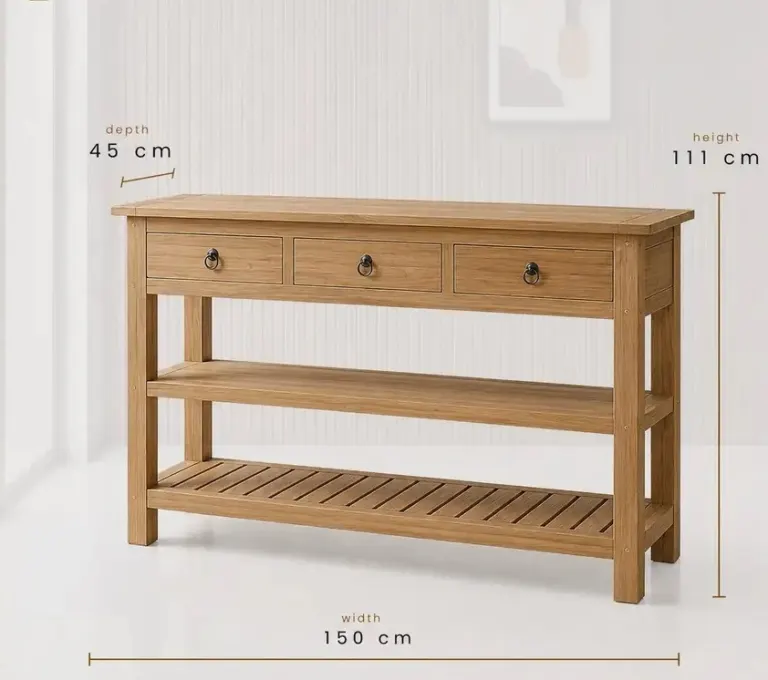
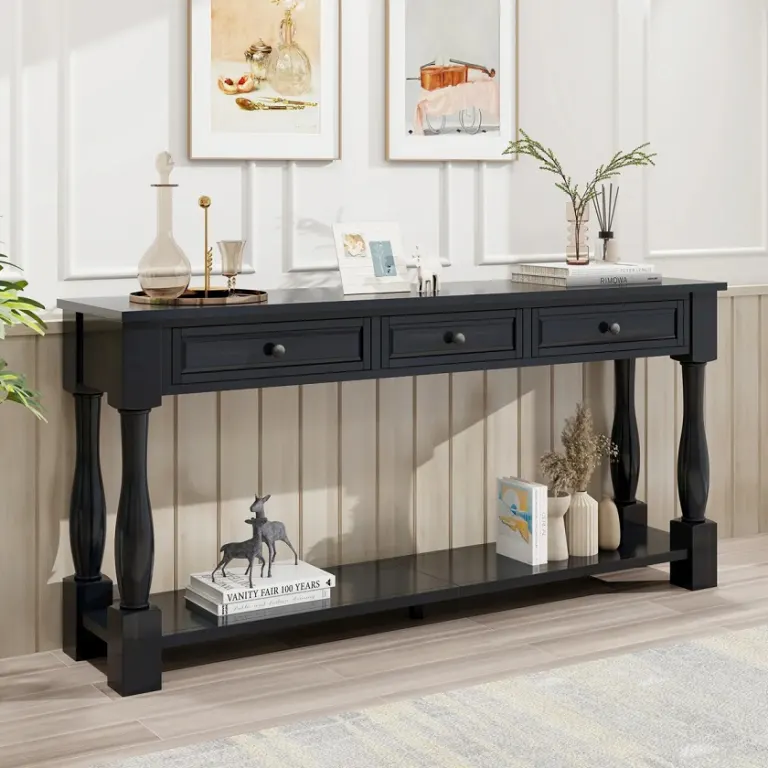
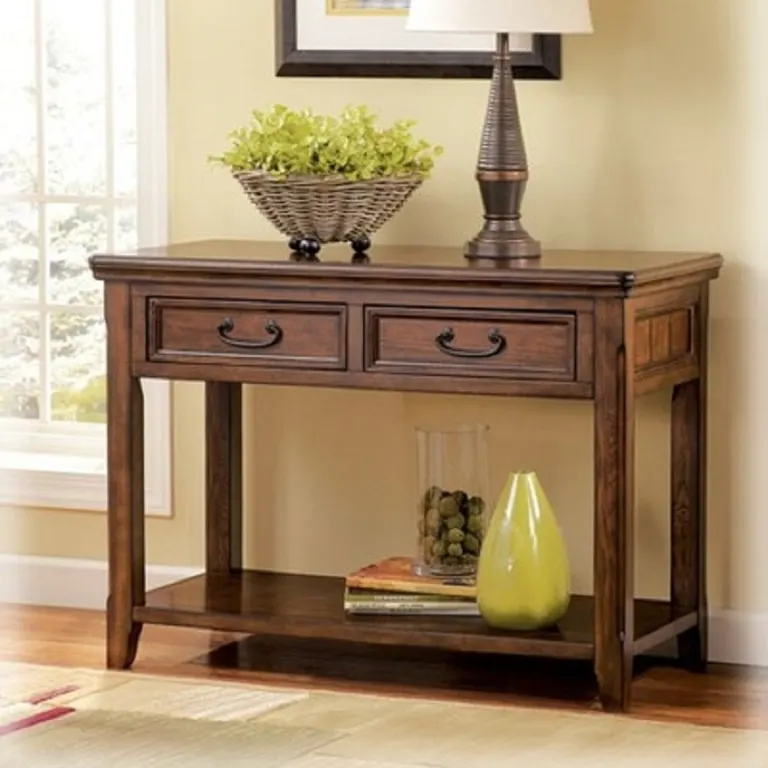
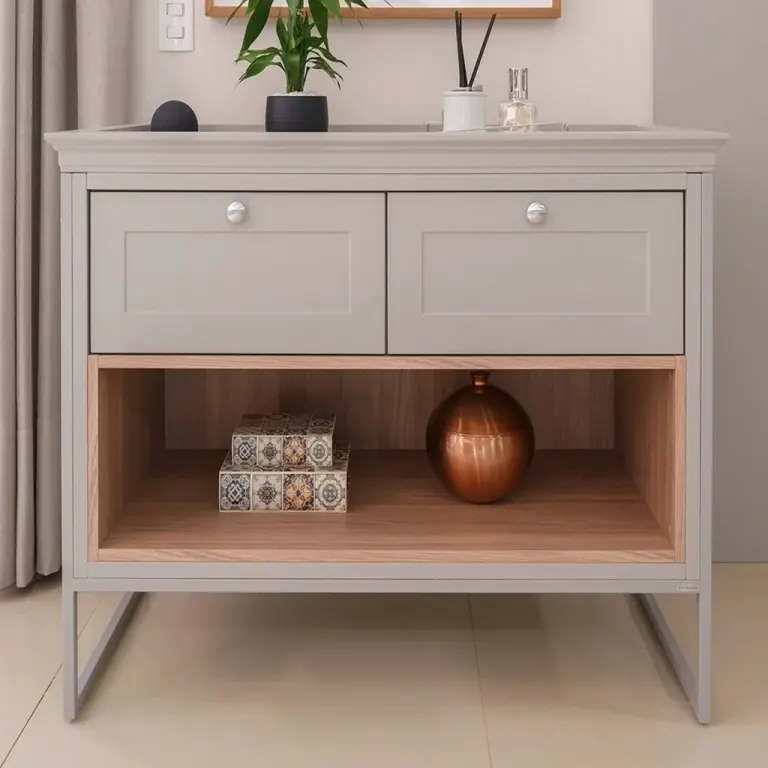
The easiest console table to install is a freestanding piece delivered fully assembled, with fixed legs and no on-site fitting beyond placing it and, where required, adding a discreet anti-tip fixing. For many projects this is the most dependable route, provided the shipping volume and lift access allow it.
Freestanding models
Freestanding consoles with a solid frame or panel base need very little from local labour. Adjustable feet can compensate for uneven floors, which are common in new buildings still settling or in renovated structures. Specify feet that can be adjusted from above or from the side without tilting the piece.
Wall-mounted models
Floating consoles look elegant but depend on the wall behind them. If wall construction is uncertain, or if installers are inexperienced with heavy fixings, a wall-mounted model adds risk. If you do choose one, ask for a fixing detail that suits several wall types and a clear drawing showing the mounting rail position. See our discussion of wall-mounted floating console tables for fixing and load considerations.
Knock-down models
Knock-down construction reduces shipping volume, which can matter for remote destinations where freight is expensive. However, it moves assembly to site. If you have limited local installers, use knock-down only where the assembly is truly simple, such as legs that attach to the top with captive fixings, and where the instructions are visual and unambiguous.
Reduce the number of variants
Every additional console model, size and finish multiplies the number of spares you should hold and the number of instructions an installer must understand. In a remote project, restraint is practical. Consider using one or two console designs across the hotel, perhaps in two sizes, rather than a different piece for every location.
A smaller range also helps with reorders. If a piece is damaged two years after opening, a single clearly documented design is much easier to reproduce than a mixed range with many one-off details.
Plan spares before the first shipment
Spare parts for an overseas hotel are far cheaper and faster to include in the original order than to organise later. The goal is not to stock complete spare tables for every location, but to cover the parts that are most likely to be damaged or lost and that a local team can replace without help.
A sensible spares list may include:
- Adjustable feet and fixing screws, in the exact type used.
- Anti-tip brackets and wall plugs suited to the wall types on site.
- Drawer runners or hinges, if the model has them.
- Replacement tops or panels for the most exposed locations, such as lobbies, where damage is most likely.
- Touch-up kits matched to the production finish.
Agree the quantities with the factory according to the number of consoles, the locations and the risk of damage. Quantities depend on the project, so we prefer to discuss them with your drawings in hand rather than apply a fixed percentage.
Label and store spares properly
Spares are only useful if staff can find them and know what they are. Ask for each spare to be packed in a clearly marked carton, referenced to the finish code and model name in the handover documents. Keep them in a dry, temperature-stable room on site rather than in a general store.
Make the instructions easy to follow
When local expertise is limited, documentation becomes part of the product. Good instructions assume that the installer has not seen the furniture before and may not read English fluently.
Ask the factory to provide:
- An exploded or step-by-step drawing for any piece that needs assembly or fixing.
- A simple placement plan referring to room or area numbers.
- Fixing details with hole positions, fixing type and wall conditions suitable for each.
- A short list of tools needed, so the contractor can prepare in advance.
- Photos or a short video showing the finished installation, where practical.
Keep text brief and use pictures wherever possible. If your site team works in another language, arrange for key instructions to be translated before shipping instead of improvising on site.
Choose materials and finishes that forgive local conditions
In some markets, climate, humidity or rough handling during storage can cause problems before the hotel even opens. Think about the building conditions during the fit-out period, not only the finished hotel.
- Timber: kiln-dried wood and well-made panel construction are less likely to move when the building is not yet climate-controlled.
- Finishes: a durable, repairable finish is more practical than a delicate one that needs specialist application to touch up.
- Tops: if stone or glass is used, think carefully about handling and whether a local team can lift the piece safely. A timber top can be easier to manage.
- Edges: slightly softened edges resist chipping during transport and installation better than sharp ones.
For more on this, our guides to console table finishes for high-traffic hospitality and choosing wood species for console tables go deeper into the options.
Pack for the journey and for site handling
Remote destinations often involve more handling points, longer storage and sometimes less careful unloading. Packing should be robust enough for this reality: protected corners, wrapped surfaces, crates or cartons that can be stacked and labelled with area numbers.
Ask for photographs of the packed goods before shipping, and agree who will inspect delivery on arrival. Recording damage with photos at the moment of unloading makes any claim much easier to resolve. Choose shipping terms such as FOB, CIF or DAP according to how much logistics responsibility your team can manage locally; where you have limited on-site support, DAP can reduce the number of steps you handle yourself, although what is practical depends on the destination.
Use a mock-up and sample even if the site is far away
It is tempting to skip a sample when the project is remote and time is short. In practice, this is when a sample is most valuable, because a problem discovered on site is far harder to fix. A single approved console, checked for finish, proportions and installation method, can prevent an error repeated across many pieces.
If you cannot visit the factory, ask for detailed photos and video from several angles and in different light, and ask the factory to show how the piece will be fixed or levelled. Our article on console table mock-ups and prototypes explains what to check before approving mass production.
Plan the opening schedule realistically
Lead times for custom furniture depend on the quantity, materials, finishes and approval speed, so we cannot give a fixed figure without seeing your project. What we can say is that remote projects benefit from building extra time into the programme for shipping, customs clearance and any site delays.
Working backwards from your target opening date, agree milestones for drawing approval, sample approval, production, shipping and delivery to site. If you work with us, we can share a production schedule and regular progress updates so that you are not left guessing.
A practical checklist for remote project furniture supply
- Confirm the number of console models and sizes, and keep the range small.
- Prefer freestanding, fully assembled pieces unless shipping volume demands otherwise.
- Specify adjustable feet and a straightforward anti-tip fixing.
- Agree a spares list with the first order, including finish touch-up materials.
- Request visual installation instructions and, if needed, translations.
- Approve a sample before production starts.
- Agree packing, shipping terms and delivery inspection responsibilities.
- Keep a handover pack with finish codes, drawings and contact details.
Next step
Palmiye produces custom wooden console tables in our Istanbul factory to your drawings and ships worldwide. If you are planning a hotel opening where local support is limited, send us your drawings, room or area list and destination. We will review the project and suggest suitable models, a spares plan and a delivery approach for your situation.
Sıkça Sorulan Sorular
Which console table type is easiest to install in a remote location?
A freestanding, fully assembled console with adjustable feet is usually the easiest. It needs little more than placing, levelling and a simple anti-tip fixing. Wall-mounted and knock-down models rely more on local skills and wall conditions, so they carry more risk where installers are limited.
What spare parts should I order with hotel console tables?
Typically feet, fixings, anti-tip brackets, hinges or runners if fitted, and a finish touch-up kit. For exposed lobby pieces, a spare top or panel may also be useful. The right quantities depend on the number of pieces and locations, so we agree them with each project.
Can you supply instructions for installers who do not speak English?
Yes, we can prepare visual, step-by-step instructions with minimal text. If your site team needs another language, it is best to arrange translation of the key steps before shipping. Clear drawings and photos usually matter more than long written explanations.
Do you make custom console tables for hotels in any country?
We manufacture to order in Istanbul and ship worldwide. Shipping terms, packing and delivery planning depend on the destination, so we discuss these with you early. Send your drawings and location, and we will advise on practical options for your project.
Should I order a sample if the hotel site is far away?
Yes. A remote site makes problems more expensive to correct, so approving one sample before production is sensible. If you cannot inspect it in person, request detailed photos and video showing finish, proportions and the installation method.
Every hotel project is different. Send us your drawings or room schedule for a tailored proposal on materials, lead time and shipping.