Entryway Console Tables for Boutique Hotel Reception Desks and Check-In Areas
A reception console table is a compact secondary surface that supports the main desk: for keys, brochures, bell, lamp or a concierge tablet. This guide explains how to size, build and specify these small pieces for boutique hotels.
A reception console table is a small-format wooden piece that sits beside, behind or opposite the main front desk and takes on the jobs the desk should not carry: holding a welcome tray, a lamp, printed maps, a card terminal or a luggage tag station. In boutique hotels, where the lobby is often compact, this secondary surface keeps the check-in area tidy and gives guests a place to put down a bag or passport. This article looks at these supporting pieces, not the statement console in the main lobby, and explains what to specify before you order.
What a secondary reception console actually does
The main desk is a working counter. It carries the PMS terminal, printers, telephones and staff paperwork, so it quickly becomes busy. A smaller console nearby separates guest-facing items from staff equipment and makes the arrival sequence feel calmer.
Typical roles include:
- Concierge surface: maps, local recommendations, a tablet stand or a small bell.
- Welcome point: a tray for water, towels or a signature scent, plus a lamp.
- Overflow check-in position: a standing-height spot for a second staff member during peak arrivals.
- Key and card station: a discreet place for key card encoders or pre-prepared envelopes.
- Display edge: local crafts, flowers or brand objects that reinforce the hotel identity.
Decide which role the piece plays before choosing a model, because each one changes height, depth and storage needs.
Sizing a hotel front desk console
Small does not mean arbitrary. The dimensions depend on whether guests stand at the piece, lean on it or only pass by it. As a starting point for discussion with your designer, the ranges below are common in practice, but always confirm against the room plan and local accessibility rules.
| Use | Typical height | Typical depth | Typical length |
|---|---|---|---|
| Decorative welcome console | 75-85 cm (29.5-33.5 in) | 30-40 cm (12-16 in) | 90-140 cm (35-55 in) |
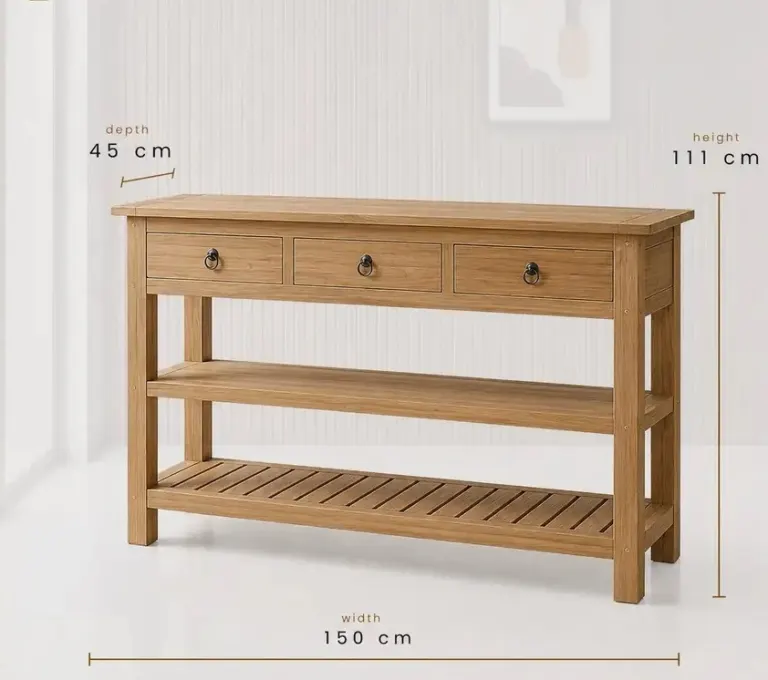
| Concierge or tablet surface | 90-105 cm (35.5-41 in) | 40-55 cm (16-21.5 in) | 100-160 cm (39-63 in) |
| Overflow check-in position | 100-110 cm (39-43 in) | 45-60 cm (18-23.5 in) | 120-180 cm (47-71 in) |
Taller pieces suit standing interaction, while lower ones read as furniture rather than a counter. If guests will sign or write at the piece, consider adding a lower section or a separate accessible position so the arrival area works for everyone.
Clearances around the piece
Check the circulation space in front of the console, especially near the entrance door, lift lobby and luggage route. A piece that looks fine on a render can obstruct a luggage trolley in reality. Mark the footprint on the floor during site review and walk it with a loaded trolley if the route is tight.
Design choices that suit boutique entrances
Boutique hotels usually want furniture that feels like part of the brand story, not catalogue stock. That does not require complex construction. Small adjustments to proportion, leg shape, edge detail and finish are often enough to make a console feel specific to the property.
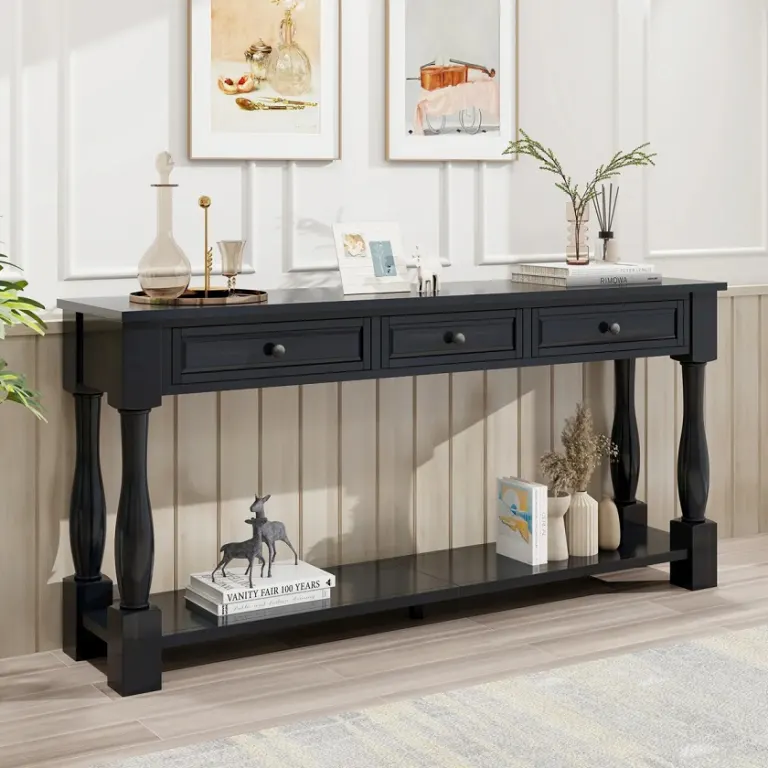
- Slim frame with open legs: keeps a small lobby feeling light and visually spacious.
- Closed base with a door or drawer: hides chargers, spare key cards and stationery so the top stays clean.
- Back panel or upstand: protects the wall behind and can hide cables.
- Contrasting top: stone, glass or a darker timber top on a wooden base adds a focal point without enlarging the piece.
Match the piece to the main desk in colour family and material language, but avoid copying it exactly. A console in the same timber with a different form usually looks more considered than a miniature desk.
Materials and finishes for a high-contact entrance
The entrance is the first area to receive luggage knocks, wet umbrellas, fingerprints and cleaning products. A top that looks good in a sample photograph still has to survive daily wiping.
- Timber species: oak, walnut, ash and beech are all used in hospitality joinery. Choose according to the colour you want and the budget, and ask for a sample in the actual finish.
- Veneer vs solid wood: quality veneer on a stable core gives a consistent grain across several pieces, while solid wood can be refinished more times. Both are valid; the right choice depends on the design and the maintenance plan.
- Protective coatings: a hard-wearing lacquer resists liquids and cleaning chemicals better than a light oil, while oil is easier to spot-repair. Ask for the finish to be tested against the cleaning products your housekeeping team will use.
- Edges and corners: slightly rounded edges reduce chipping where trolleys and bags make contact.
Power, data and cable planning
Many reception consoles end up carrying a lamp, a card terminal or a tablet. Decide this at the drawing stage, not after delivery. A small cable cut-out, a grommet in the top or a vertical channel in the back panel keeps wires out of sight and prevents makeshift fixes on site.
Coordinate socket positions with the electrical contractor and give the factory the exact wall dimensions. If the piece will be fixed to the wall, confirm the wall type early so the fixing method suits it.
Stability and fixing
Guests lean on reception furniture, and children sometimes pull at it. Even a light console should be stable in normal use. Wall fixing, adjustable feet for uneven floors and a sensible base proportion all help. Tell your supplier if the piece will carry a heavy lamp, a tablet stand or a stone top so the structure is designed for the load.
Ordering a custom reception console from Turkey
Palmiye produces made-to-order wooden furniture in its own factory in Istanbul and supplies hotel projects worldwide. For small secondary pieces like these, the process is usually straightforward when the brief is clear.
- Send the brief: a plan showing the position, target dimensions, quantity, preferred timber and finish, and any photos or sketches of the style you want.
- Receive shop drawings: elevations, sections and key joinery details for your approval.
- Approve a sample: a finish sample or a prototype lets you check colour, edges and proportions before production.
- Production and inspection: pieces are made to the approved drawings and checked before packing.
- Packing and shipping: export packing protects surfaces and legs in transit, and shipping terms such as FOB or DAP are agreed with you in advance.
Timing and cost depend on the quantity, materials, finish and approval speed, so we confirm them against your project programme rather than quoting a fixed figure. If the console is part of a wider FF&E package, it can be produced alongside lobby and guest room items to keep finishes consistent.
Checklist before you finalise the specification
- Which role will the console play: decorative, concierge or working position?
- Are the height and depth suitable for standing use and for accessibility needs?
- Is there enough clearance for luggage trolleys and passing guests?
- Does the top finish suit daily cleaning products?
- Are cable routes, sockets and wall fixings coordinated with the electrical plan?
- Have you approved a sample in the actual finish and lighting?
- Are packing method, shipping terms and delivery address confirmed?
Next step
If you are planning a boutique hotel entrance or renovating a check-in area, send us your plan, a sketch or a reference photo. We will review the brief and come back with drawing proposals, material suggestions and shipping options for your destination.
Sıkça Sorulan Sorular
What is a reception console table used for in a hotel?
It is a secondary surface near the main desk that holds guest-facing items such as maps, a lamp, a welcome tray, a tablet stand or a key card station. It keeps the front desk clear for staff equipment and gives guests a place to rest bags or documents during check-in.
What height should a hotel front desk console be?
It depends on the use. Decorative welcome consoles are often around 75-85 cm (29.5-33.5 in), while concierge or standing positions are typically 90-110 cm (35.5-43 in). Confirm the final height with your designer and check accessibility requirements for the destination country.
Can a console table hide cables for a card terminal or tablet?
Yes. A cut-out, grommet or vertical cable channel can be built into the top or back panel. Share the socket positions and equipment list at the drawing stage so the factory can place openings correctly and keep the surface tidy.
Is solid wood or veneer better for a check-in console?
Both work. Veneer on a stable core gives consistent grain and is well suited to repeated pieces, while solid wood can be refinished more times. The right choice depends on the design, budget and how you plan to maintain the furniture.
Can Palmiye make a custom reception console and ship it internationally?
Yes. We manufacture to project drawings in our Istanbul factory and ship worldwide. Send your plan, sketch or reference photo, and we will propose drawings, materials and shipping options. Timing and cost are confirmed against your quantity, finish and programme.
Every hotel project is different. Send us your drawings or room schedule for a tailored proposal on materials, lead time and shipping.